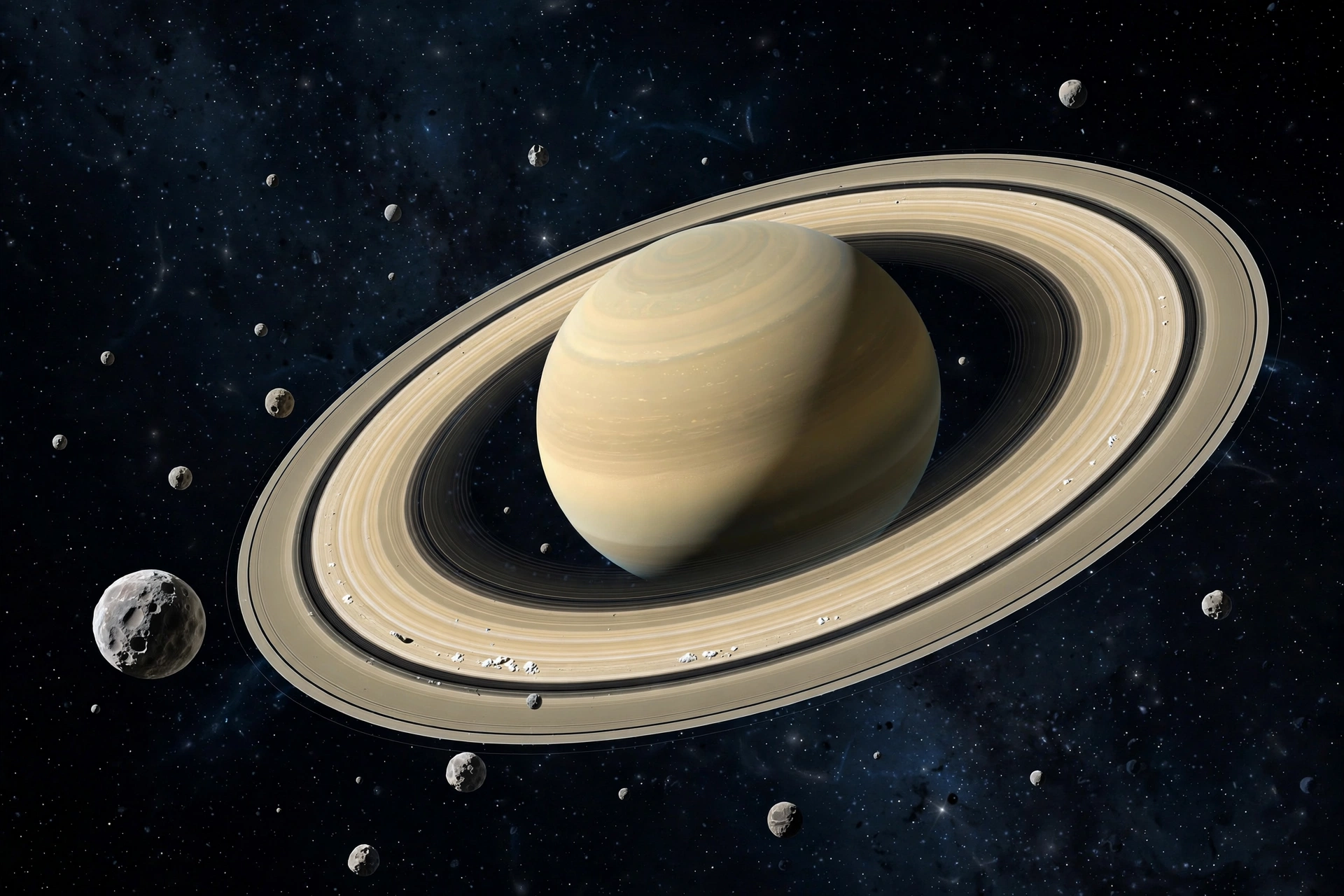
Saturn has pulled even further ahead in one of the solar system’s most charming contests. Astronomers have confirmed 128 additional moons orbiting the ringed planet, a haul that lifts its official total to 274 and leaves every other world trailing far behind. The new moons were identified through observations made with the Canada-France-Hawaii Telescope, and the discoveries have now been recognised by the International Astronomical Union, the body responsible for formally naming and cataloguing celestial objects. For readers who enjoy a lighter change of pace between stories, our recent entertainment coverage includes the Natalie Portman thriller everyone is talking about.
How the new moons were found
The moons did not announce themselves in a single dramatic moment. Instead, researchers at the University of British Columbia and partner institutions spent years stacking and comparing telescope images, watching for faint points of light that moved against the background stars at exactly the same rate as Saturn itself. Most of the new arrivals are tiny, only a few kilometres across, and so dim that earlier surveys simply missed them. By returning to the same patches of sky again and again, the team could link separate sightings into proper orbits, proving that each speck genuinely belonged to Saturn rather than drifting through the frame by chance.
Why Saturn keeps winning the moon race
Part of the answer is Saturn’s sheer gravitational reach. The planet is enormous, and its influence extends across a vast region of space, giving it a huge territory in which passing rocks can be captured and held. Many of its smaller moons are thought to be fragments of larger bodies that broke apart after collisions long ago, which would explain why they travel in loose families with similar orbits. Jupiter, Saturn’s great rival, currently has 95 recognised moons, a respectable figure that now looks modest by comparison. Uranus and Neptune, colder and farther away, have far fewer confirmed companions between them.
What these tiny moons can teach us
Small moons are more than collectable curiosities. Because many of them appear to be shards from ancient smash-ups, studying their sizes, colours and orbits helps scientists reconstruct what the young solar system was actually like. Collisions were once routine in the crowded neighbourhood around the gas giants, and every fragment is a fossil from that violent era. The distribution of the new moons may also reveal how Saturn’s rings and inner moons interacted over billions of years, and whether some captured objects arrived from much farther out, near the Kuiper Belt.
A record that may not stand still
Nobody involved in the research is treating 274 as a final answer. Telescope technology keeps improving, and each new survey tends to find smaller and fainter objects than the last. The same patient technique that produced this announcement could easily turn up dozens more candidates in the coming years, each requiring careful follow-up before it can be confirmed. There is also lively debate about where a moon stops and a ring particle begins, since Saturn’s rings contain countless icy chunks, some large enough to stir the ring material around them as they travel.
Names, fame and the small print
Most of the 128 newcomers will be known for now only by provisional designations, strings of letters and numbers that record when and where they were first seen. That is normal in astronomy, where a moon must prove it can be found again before it earns anything grander. A handful may eventually join famous company alongside Titan, Enceladus and Mimas in the public imagination, but most will live quiet lives in catalogues, known to specialists and treasured by them. There is no shame in that. The history of science is built largely on patiently recorded objects that nobody outside a small community could pick out of the sky, yet which changed what that community understood about everything else.
What happens next
The newly confirmed moons will now receive official designations, and in time some may be given names drawn from mythology, following the tradition applied to Saturn’s larger moons. Follow-up observations will refine their orbits and, where possible, measure their reflectivity, which hints at what they are made of. For the public, the headline is simple enough: the planet famous for its rings is also, by a remarkable margin, the planet of moons. Look up on a clear night this month and Saturn will appear as one steady point of light, quietly accompanied by a retinue of 274.